01/12/2010

16/07/2010
The Last Bean
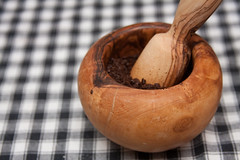 This is how I make coffee. It’s a bit of a process, but I stand by my theory that humans need process for sanity. The first step is grinding. I take the Caffe Umbria Mezzanote blend beans (my personal favorite decaf), and pour about a half a cup to be ground via mortar and pestle. This particular mortar and pestle came from a little shop in Italy that my wife and I visited during our year learning Italian at Villa Aurora, Firenze. Oddly enough, we didn’t purchase this while there, but instead it was gifted to us by my mother, who ordered it overseas.

The perfect grind is achieved when there is one last unbroken bean. I know this because no matter how hard I try there is always one last bean that taunts me by surfacing to the top of the grounds after I think I’m done. For some time my mind has struggled to accept how this bean inevitably escapes my grinding, but after several cups I’ve learned to accept it for the anomaly that it truly is and carry on. If you see two or three, keep grinding.
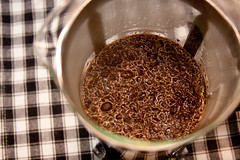 Next the beans go into the press, and you pour the hot water in, ready to stir them so they don’t sit stagnantly. You can get your hot water from anywhere (Instahot is handy, but I use our tea kettle). Once in, stir the beans lightly, enough to allow each piece to get a good bath, but not so much that you kill the froth the beans’ odoriferous oils produces.
 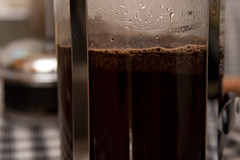 I use a long silver spoon for this step, but you can use whatever you want. Just be gentle with the glass of your press. At this stage you have a decision to make about just how strong your coffee is. The length of time you let it steep is directly proportionate to the amount of chest hair you’ll grow, so just be aware. I let mine go for 3-5 minutes because, let’s face it, I could use some chest hair.
 Next, you push the plunger of the press down. This is a favorite step for me—perhaps because it means the coffee’s done, or maybe just because it’s fun to press it. After that, make sure the lid is open to pour, and fill up your favorite mug.
  The right mug can enhance the drinking experience. This time I chose one of my wife’s favorites, primarily because it was smaller, but also because I like the branding (sure, call me a brand-whore).
So that’s it. It’s a pretty simple process, but it’s one I’ve grown to love. I don’t even think I’d accept a lifetime supply of Starbucks VIA® Ready Brew (though I hear it’s quite good). I just couldn’t give up the appreciation this process instills.
06/04/2010
Left Out

You know that awful, helpless feeling of knowing that everyone thought of you, but thought twice? These chaps probably spent their lives wishing they could be part of the “normal” crowd.
Now, not many of us have troubles as evident as these fellows, but in a dog-eat-dog world it's pretty easy to find faults. It could be that you have a funny habit, that you need to comb your hair, or maybe that you're (forbid the thought) unique.
So, what are you supposed to do when you're the odd one out? You don't want to be a tag-along, or a complainer, and the natural response is to seclude yourself and stew. But when it comes down to it, stewing only makes you less personable, stressing the problem.
When I was a kid I learned a trick that helped me to stay positive: I thought about my most loyal friend. While it was natural to say “I don't have a friend in the world”, this thought allowed me to add an “except...” to the sentence. Even though that friend was seldom around when I felt down, just remembering that there was someone who was still my friend made me feel better—still not great—but better.
Subscribe to:
Posts (Atom)
